- Gohan
- October 15, 2025
- Comments (0)
Does Test Cricket Need a Two-Tier System?

The Empty Stands That Spoke Volumes
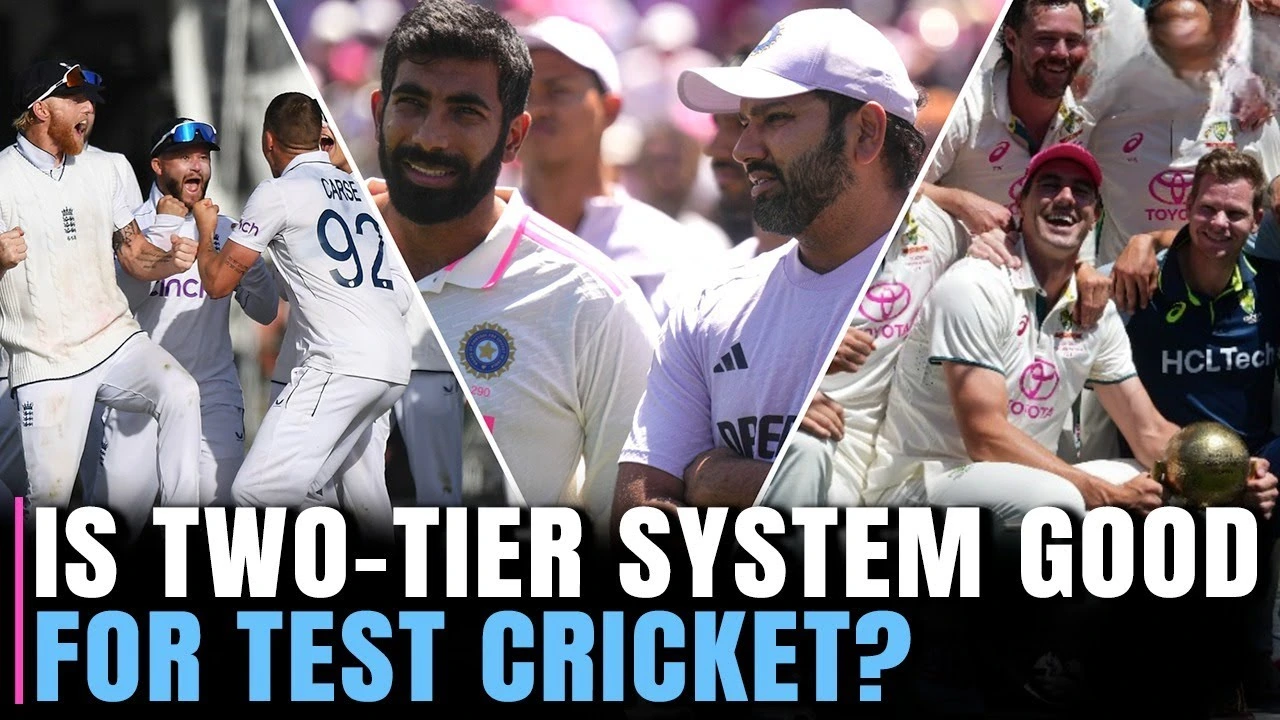
The question of whether Test cricket needs a two-tier system isn’t new — but every time India faces the West Indies in front of half-empty stands, it becomes louder.
The recently concluded series in Ahmedabad offered a sobering reminder. Despite India’s dominance, the stands were nearly deserted — a sight that reflects the widening gap between cricket’s top nations and its struggling members.
The contest was over in three days, continuing a pattern that’s become all too familiar. West Indies, once the giants of world cricket, have now lost all six away Tests to India since 2013 — four of them by an innings. Even after India declared generously and hesitated to enforce the follow-on, the Caribbean side couldn’t mount a serious challenge.
For Indian fans, this was a far cry from the thrill of their last Test engagement — a gripping five-match series against England that swung back and forth with late finishes and high drama. From England’s 371-run chase at Headingley to Harry Brook and Jamie Smith’s counterattack at Edgbaston, the series embodied the best of the format.
Unfortunately, such riveting contests have become rare outside the “Big Three.” And that brings us back to the burning question: should Test cricket adopt a two-tier structure to restore competitiveness?
The Decline Beyond the Big Three
The World Test Championship (WTC) was designed to give every series meaning, ensuring every Test had points and purpose. It worked, to an extent — matches became more result-oriented, and the first three editions crowned three different winners.
But the deeper truth remains unchanged: the gulf between elite teams and the rest is widening. India, England, and Australia continue to dominate in both performance and fan engagement, while nations like West Indies, Bangladesh, and Zimbabwe are left struggling for relevance.
The disparity isn’t just on the scoreboard. It’s visible in empty stadiums, low TV ratings, and reduced commercial interest.
To illustrate the gap — since the WTC’s inception in 2019, the top six teams (India, Australia, England, South Africa, New Zealand, and Sri Lanka) have a staggering win-loss ratio of 5.23 against the lower six (Pakistan, West Indies, Bangladesh, Ireland, Afghanistan, and Zimbabwe). Nearly one in three of those wins came by an innings margin, and many others were sealed inside three days.
Such numbers make a strong case for restructuring the Test ecosystem.
Should Test cricket move to a two-tier system? 🤔 pic.twitter.com/pKcrOaRYVa
— Cricbuzz (@cricbuzz) October 14, 2025
Why the Two-Tier Idea Is Gaining Traction
The two-tier Test system proposal envisions two divisions of six teams each, with promotion and relegation after every WTC cycle. The concept aims to reward merit, boost competition, and ensure that teams play opponents of comparable strength more often.
This idea isn’t without precedent. In football, tiered leagues have long sustained competitiveness and excitement. In cricket, it could mean:
- Division 1: India, Australia, England, South Africa, New Zealand, Sri Lanka
- Division 2: Pakistan, West Indies, Bangladesh, Ireland, Afghanistan, Zimbabwe
While not official, this hypothetical lineup highlights the clear performance divide.
At first glance, the model offers logic and fairness — struggling teams would rebuild confidence against similar opposition, while elite teams face tougher, more meaningful battles. Fans would get evenly matched contests, reducing the frequency of one-sided whitewashes.
The Popularity Divide: England, India, and Australia Lead the Way
Crowd attendance offers another telling indicator.
The 2024 Boxing Day Test between India and Australia in Melbourne drew a remarkable 373,000 fans over five days. Meanwhile, Ahmedabad barely filled a fraction of its seats when India hosted the West Indies.
It’s not just in the stadiums — digital engagement mirrors the same trend. The England vs India Test series in 2024 became the most-watched Test contest ever online, with sold-out venues and record-breaking viewership.
Former England captain Nasser Hussain summed it up aptly on Sky Sports:
“We’re very lucky in England that every Test match here is nearly sold out. We shouldn’t take that for granted.”
Clearly, Tests involving the Big Three are thriving — but those beyond are fading fast.
🗣️“If you want Test cricket to survive, you need a two-tier system.” 🏏
— Wisden (@WisdenCricket) June 27, 2025
Do you agree with Ravi Shastri’s vision for the future of the red-ball game? pic.twitter.com/iSYCgi9GPD
The Decline of Pakistan and West Indies
Among the bottom-tier teams, Pakistan and West Indies exemplify the problem.
Pakistan were ranked No.1 in 2016 but have since suffered a steep fall. Since the WTC began, they’ve played 40 Tests — winning just 13 and losing 20. Against top-tier teams, their record is even bleaker, with no Test wins in SENA countries since 2019.
West Indies’ story is even more disheartening. Once the undisputed kings of the 70s and 80s, they’ve now gone 11 losses in their last 14 Tests. Their only bright moment — Shamar Joseph’s heroic Gabba performance in 2024 — now feels like an isolated miracle.
In their last 15 innings before the Delhi Test, the West Indies crossed 200 just twice, often collapsing before the second new ball. Their home whitewash against Australia and the infamous 27-all-out innings underline how far they’ve fallen.
These numbers raise a painful truth: the romanticism of Test cricket cannot survive if matches remain this lopsided.
The Uneven Distribution of Matches
Since the WTC’s launch, the number of Tests played per team further emphasizes the imbalance.
- England have played 78 Tests, including six five-match series.
- India: 63 Tests with multiple five- and four-match series.
- Australia: 57 Tests with similar multi-match engagements.
Meanwhile, teams like Bangladesh, Zimbabwe, Ireland, and Afghanistan barely play two-match series, often years apart.
This inequality limits exposure and experience for developing cricket nations. Even top-tier teams like South Africa and New Zealand find themselves with fewer long series — highlighting how the current WTC schedule already leans toward the Big Three.
Could a Two-Tier Format Revive Global Competitiveness?
Supporters of the model argue that a promotion-relegation format would create genuine stakes for every team.
Lower-tier nations would have achievable goals, regularly competing for promotion rather than merely fulfilling fixtures. The top division, meanwhile, would guarantee high-intensity contests — a better product for fans and broadcasters alike.
Additionally, players from emerging nations could gain confidence through evenly matched competition, instead of facing demoralizing defeats. Over time, this could raise the overall standard of Test cricket.
The Flip Side: Tradition vs Transformation
However, purists argue that Test cricket’s charm lies in its universality — the idea that any nation can challenge any other. Introducing rigid divisions might erode that spirit.
Moreover, the promotion-relegation model could risk alienating smaller boards financially. Without the incentive of hosting top teams like India or England, gate receipts and sponsorships could plummet. The very teams that need nurturing might instead be pushed further into isolation.
A potential compromise could be a hybrid WTC model, retaining a single points table but introducing weighted fixtures or separate conferences — allowing flexibility without fully dividing the format.
Micheal Holding said this back in 2018 about having 2 divisions in Test Cricket.
— Ragav 𝕏 (@ragav_x) January 6, 2025
As he'e saying it's not happening anytime...
But now even then if ICC brings in 2 divisions, the moment one of the big 3 gets relegated, the division system will be taken away anyways. pic.twitter.com/gqHwR8A57p
The Way Forward for Test Cricket
Whether or not a two-tier Test system becomes reality, one thing is certain — Test cricket needs structural reform.
The ICC must address:
- Scheduling parity, ensuring more balanced opportunities for all nations.
- Financial redistribution, helping smaller boards sustain longer series.
- Fan engagement, through better broadcast timing and storytelling.
- Pitch standardization, to encourage fair competition.
Ultimately, Test cricket’s survival depends not on tradition alone but on adaptability. The WTC was a step forward, but perhaps not far enough.
Final Verdict: Evolution, Not Exclusion
So, does Test cricket need a two-tier system?
Perhaps — but only if implemented wisely. A well-designed structure could revive competitiveness, attract fans, and preserve the sanctity of the format.
Yet, it must avoid turning Test cricket into an exclusive club for the elite. The format’s greatest beauty lies in its diversity — from the Caribbean’s flair to Pakistan’s artistry and New Zealand’s grit.
The challenge ahead is clear: to make every Test meaningful again — whether it’s India vs England at Lord’s or Bangladesh vs Zimbabwe in Dhaka.
If the ICC can strike that balance, the longest format might just reclaim its rightful throne as cricket’s truest test.